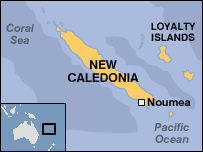
This blog on New Caledonia is for those of you who ever wondered what life on a tiny island in the South Pacific might be like. Tired of bracing winter winds, the stress of an inner city or simply dreaming of a life change? This is a blog about what happens when, in the words of Yogi Berra, "you come to a fork in the road, [and] take it".

Showing posts with label History. Show all posts

27 July 2007

Rock of Contention: Free French and Americans at War in New Caledonia, 1940-1945

For those of you interested in the American influence on New Caledonia (which was, in truth, a bone of contention with the French government), I recommend Kim Munholland's "Rock of Contention: Free French and Americans at War in New Caledonia, 1940-1945".


The following excerpts are from a review of the book by Robert Aldrich, University of Sydney in H-France Review Vol. 6 (April 2006), No. 47:

Rock of contention

"The Americans, under the command of General Patch and then Admiral Halsey, overwhelmed New Caledonia with their men and machines. The presence of tens of thousands of soldiers and their matériel, the demands they made on local accommodation, the largesse of American dollars and the military exigencies they imposed all grated on the French. De Gaulle and his comrades in London reacted angrily to what they saw as the bossiness of American officers and to what they feared was Washington’s aim of taking over the French colony at the end of the war.

The French governors, in the American perspective, placed obstacles in their way, even to the point that an American official thought that one governor ought to be charged with abetting the enemy.

The French, on their side, sometimes said that the Americans posed more of a threat to New Caledonia than did the Japanese.

In fact, as Munholland justly points out, two priorities clashed: the American determination to take whatever measures necessary to win the war in the Pacific, the French determination to keep control over New Caledonia and to retain sovereignty over their overseas empire."

The American influence on the ground

"The American presence could not but bring great changes, at least temporarily, to New Caledonia. 'One might have said the Martians had landed' one Kanak student is reported as remarking.

The population of Nouméa soared, especially as the Americans put up Quonset huts, built an airport and constructed a “mini-Pentagon” at a beachside suburb. GI’s spent dollars lavishly for food, drink and other entertainments--86 bars opened in Nouméa during the war, and by 1944, the Trade Winds bar (*) alone sold 18,000 beers and 5,100 hamburgers a day ...

Many Melanesians were astounded at the sight of African American troops in positions of responsibility (despite the segregation practiced by the US Army). Many Kanak, and Asians, found employment with the Americans, and were even paid for their work--Kanak had been required by the French to donate free labour for public works projects. Although only a quarter of the Melanesians had held paid jobs before the war, during the American years two-thirds had such an experience.

Similarly, many of the Caldoches benefited from the American presence and the opportunities it provided; the Spanish-born head of the local Communist Party (and a Republican in the Spanish Civil War) sold bootleg liquor to US soldiers for what they claimed were exorbitant prices."

* Readers may recall that we know of someone who worked at the Trade Winds ... Lucie Agez.

My thanks once again to Marc ("Le Cagou") for sharing this with us.

23 July 2007

Consequences of the American Presence in New Caledonia

A bridge built by the US army, Poya, New Caledonia

On 12 March 1942, a large convoy of 17 000 American army soldiers, under the orders of General Patch, landed in Noumea - which then became Pacific headquarters (to stop the advance of the Japanese during World War II).

Airports were built (Tontouta, Gaiacs Plain). Amunition and gasoline filled all possible ports, medical clinics were installed at Anse Vata, Conception, Dumbea, north of Bourail, on the coast and in the far north.

What tremendous upset to the country's daily life! After having endured a period of food rationing, here is what was distributed all over the island:
  • Chocolate.
  • Chewing gum.
  • Ice cream.
  • And, last but not least, whiskey!
The Americans also introduced modern farming. They cleared land with a bulldozer and planted crops with machines. They also worked with the tribes - who received salaries in dollars for the first time.

In 1944, military operations began to distance itself from New Caledonia. 1946 marked the departure of the last GIs and the return of the volunteers.

- Translated loosely from a text used in a 2005 BEP history-geography exam in New Caledonia. The subject: "What are the consequences of the American presence in New Caledonia?" (Source: Bulletin d'accueil, Vice-Rectorat de la Nouvelle-Caledonie)

Special thanks to Marc ("Le Cagou") for sharing this with us.

20 November 2006

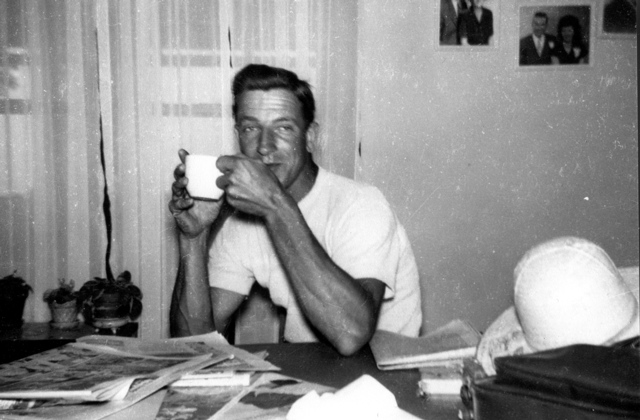
Lucie's Dashing Coffee-Drinking Soldier Man

Since my post about The Quietly Remarkable Mlle Lucie Agez, I have received both proof that her young American soldier man was a coffee lover and indeed, dashing (as pictured above). I've also learned that there were other young New Caledonian women who left New Caledonia to follow their American soldiers. One wonders how many. One wonders how many Americans have New Caledonian ancestry. One wonders how many Americans are proud of such ancestry ... in any case, many thanks to Lucie for showing young women the way of courage, strength and independence - 60 years before the world's borders opened and international travel became something of a regular occurrence.

16 November 2006

The Quietly Remarkable Mlle Lucie Agez

I have been very moved by a story that has been revealed to me over the course of this last week. It is not my story, but the story of a Ms. Lucie Agez, who is 83 years old. The story was told to me by her daughters - marvelous women I have never met - through e-mails and photos.

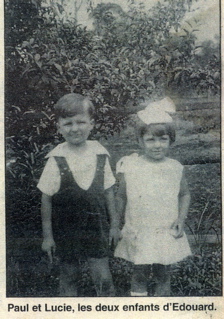
Lucie Agez was born on the southeast coast of New Caledonia, in Canala, in 1924. She was born to Caldoche parents - of German and French descent. Her childhood was idyllic until her father died when she was 12. Sadly, she and her older brother, Paul, were placed in an orphanage following her father's passing. But loss at such a tender age seems to have infused Lucie with tremendous strength and courage, which later helped her face life's later challenges.

Fast forward to World War II. In 1945, Lucie was 21 and worked at a local restaurant called the "Tradewinds". (You may recall that the Americans occupied New Caledonia during World War II - to prevent Australia from being attacked by the Japanese.) Turns out, Lucie was living with a cousin who had taken her in once she turned of age. Just across from her cousin's place there was a military radio station being guarded by a handsome young military policeman named Clarence Mickelson (aka "Mike"). Mike was also a talented mason. On his time off, he built a wall under the house Lucie and her cousin were living in. He also frequented the "Tradewinds" where he downed many a cup of java, his favourite beverage, and came to know dear Lucie.

When the war ended, the American soldiers returned home. Lucie's dashing young man, Mike, was one of them. What was to happen to our fledgling young couple?


Yes, Mike sent for Lucie. Upon arriving in the American midwest, Lucie's coffee-drinking military policeman drove across the United States to San Francisco. He wired Lucie to come.

Lucie, whose English was as fledgling as her new love, who had never left New Caledonia (a tiny unknown French-speaking island in the South Pacific), who had no promises before her beyond those proffered her by her coffee-drinking American soldier man, packed up what little she had, bought a ticket for $300-$400, boarded a cargo ship for Norway (the "Thor I"), travelled three weeks by sea and disembarked in an entirely foreign land. Folly, you say? Uncontestable courage, I say. Lucie left everything she knew behind (including a brother and cousin she loved dearly) - in 1946 as a single woman - to commence an unsure adventure where snow was exotic and unknown to her, midwestern Americans at times a little less than welcoming, and French bread, sunny skies and island life forever lost to her. (Lucie was to visit her native land nearly 30 years later when her husband died.)

Lucie and Mike went on to have four daughters and one son. She learned English and adopted American customs and traditions as her own. I believe she kept the story of her native land quietly to herself as she acclimated to the American midwest. I am certain her many grandchildren and great-grandchildren are extremely proud of her courage, heritage and strength. Lucie is truly une femme extraordinaire !

(Many thanks to Lucie and her family for giving me permission to share her story.)

10 October 2006

Sentenced to New Caledonia

Back in 1864, 248 murderers, rapists and thieves were sentenced to hard labour in New Caledonia. Their mission? To build a penal colony that would later house thousands of hard, petty and political criminals. Of the many criminals that landed on the island, only one escaped the 4-kilo chains, the handcuffs, the days literally levelling low-lying hills and building some of Nouméa's most important public buildings (e.g. its cathedral, hospital, military barracks). His name was Rochefort, a French journalist ousted from Paris by the Prussians for his political views. The rest of the prisoners, upon completion of their long sentences (to build Nouméa) were allowed to return to France (if they could afford the ticket). Those who could not afford to pay the return journey were forced to settle in New Caledonia and cultivate the land.

A subject of great taboo

75% of today's European population in New Caledonia (the Caldoches) are descendants of these prisoners. The penal colony was a subject never broached. It was almost completed razed in 1933 and was not opened or visited until 1994. A great divide had grown up between the descendants of the original prisoners and the 25% Europeans who had come to New Caledonia as free citizens. Inter-marriage was formally forbidden and many a bloody fight flew up in the face of the past. "My grandfather was not a straw-hat!" would come the calls of new generations defending their roots. (Straw hats was the term used for prisoners as this is what they wore to work under the heat of the sun.)

Today, one can visit what remains of the penal colony with the help of a guide. Asked who comes to visit the prison and museum, the answer is Japanese tourists or people who've come for a short stay (teachers, military, administrators). The Caledonians? Very few.

05 October 2006

Origins of the Name Nouméa

I learned the other day that Nouméa, New Caledonia's capital, means Sardine Island in one of the 32 Kanak dialects. Méa means island and Nou is sardine. At first one might scratch one's head ("Confusion is always the most honest response." - Marty Indik), but from above perhaps our little island does resemble a sardine.

22 August 2006

New Caledonia in BBC News

For a recently updated overview of New Caledonia, its history and its politics, see the BBC's Regions and territories: New Caledonia page. Though they mention our nickel and the wealth on the island, what they fail to mention is that the building of a second nickel mine in the south is highly controversial (and is being blocked by the locals) and that the money on the island is in the hands of the Caldoches (two major families) and the Metros. (See A Country Thrice Divided for a short description of the difference between the populations.) The Kanaks live as they can, however, many of them in squats.

03 April 2006

An American Monument in New Caledonia

Photo by Laurent Guiader, 2005.

"In honour of the US forces who by their presence during the Pacific War from March 1942 to February 1946 insured the freedom of New Caledonia. Her people are deeply grateful."

I have discovered that there is one place in the world where one does not have to be ashamed to be American. Here in New Caledonia, Americans still have a positive image, carried over from their treatment of the local population during the Second World War. They were the first to pay the Kanaks for their work and modelled equal treatment of African-American and caucasian soldiers during their stay on the island. Many New Caledonians also credit Americans with having saved their island from having been usurped by the Japanese...

Speaking of exemplary Americans, Happy Birthday Clydio!