This blog on New Caledonia is for those of you who ever wondered what life on a tiny island in the South Pacific might be like. Tired of bracing winter winds, the stress of an inner city or simply dreaming of a life change? This is a blog about what happens when, in the words of Yogi Berra, "you come to a fork in the road, [and] take it".

Showing posts with label Melanesians. Show all posts

23 January 2007

Maré: As in Death, Life

Besides its wild and remote qualities, one of the things I loved about Maré was its simplicity. By this I mean the lack of artificial barriers between good and bad, life and death, land and sea. There were no complications, no analyses, no complexities. Everything on the island was what it was.

An example of this is the Maréan burial grounds (pictured). There are no looming tomb stones to mark an end or a separation between life and death. Instead, the Maréans are buried surrounded by living plants, colour, natural wooden fences, towering palms and the sea. One would say that their burial grounds are a place of celebration, of vibrancy and of all things, life.

My thanks to the Maréans for letting me share a photo of this sacred place with you.

Photo by Laurent Guiader, 2006.

14 January 2007

Maré: Its People

Photo by Laurent Guiader, 2006.

We were lucky enough to meet and talk with some of the locals in Maré (Maréans) - not so in Ouvéa (which was where we went next). We found them to be very warm and welcoming - but not warm and welcoming in the touristy kind of way. They were genuinely open and willing to share their culture, not for money but out of pride for their island and their way of life. Unlike on the main island (Grande terre) of New Caledonia, the Maréans (largely Melanesian) control how things are run on the island (which is also true on the other Loyalty Islands and Ile des Pins). Only about 2% of the population on this island are French - so you really feel as if you are in direct contact with the locals, the minute you arrive.

On our tour day of the island, we spent a morning with our Kanak guide above (click on the photo for a larger image). Not only did he take us all over the island, but he talked about what his life was like. As it was the holiday season, and Santa Claus had arrived by boat the night before, and there had been fireworks and parties into the night and early morning, he was a little worse for the wear. (Kanaks like to party in a big way - we saw a number of them flat out from all the partying during our tour and our guide explained that all the shops were closed, because after they had been drinking, they could get aggressive and either walk out with the shops' merchandise or get into nasty fights ...)

In the photo above, our guide had just taken us down into an enormous cavity that led to an underground water hole. He explained that the names we saw on the cave walls were the result of competitions - the men like to climb the walls (as high as they can go) and then carve their names in the walls. Mind you, our guide was about 35 years old. When I asked if women and children came down into the water hole, he said that they all do. They all love to swim there - and that the more women there are, the higher the men climb.

Throughout our tour, we saw children playing in the dirt roads. We are accustomed to seeing them bare foot (you often see them running and playing soccer bare foot in Nouméa), but due to the heat, they were also entirely naked. Smiling, laughing, they would continue their games in the street despite the approach of a dusty Peugot 206 and look after us with a vague (and passing) curiosity. They made me hanker after their total simplicity and unshakable "joie de vivre".

09 November 2006

What Culinary Delights Follow Shark?

Photo by Laurent Guiader, 2006.

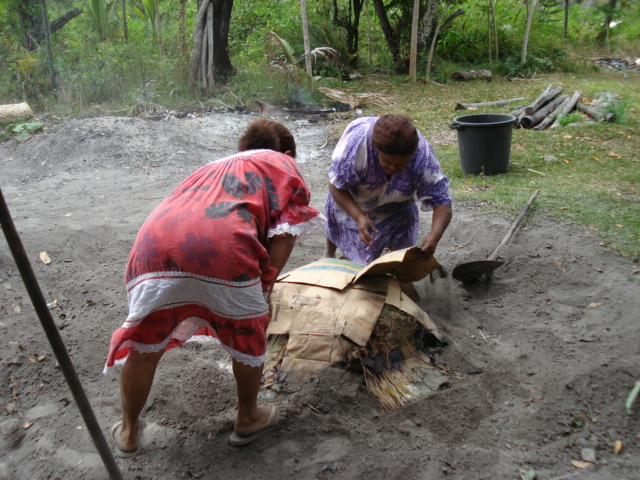
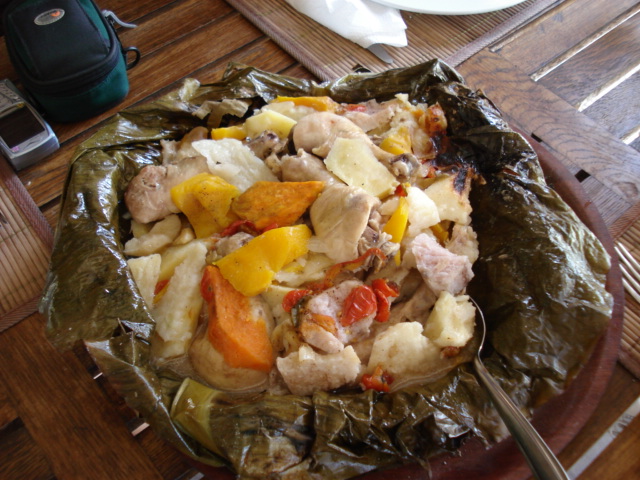
Some of you may recall mention of our tasting shark unbeknownst to us whilst on this fair island. By us, I mean Sophie. And the guilty party was Laurent. A few weekends ago, we ventured a bit further. While on Ile des Pins, we decided to partake of the lovely dish buried in the ground above: bougna. Bougna is one of the Kanaks' traditional feast dishes. It generally contains taro, yam, sweet potato, banana and either pieces of chicken, fish, crab or lobster. All of this is wrapped in banana leaves and buried to cook in the ground under hot coals. Above, our Kanak friends are uncovering the meal we later ate, below.

Photo by Laurent Guiader, 2006.

12 July 2006

Kanaky (New Caledonia)

Photo by Laurent Guiader, 2005.
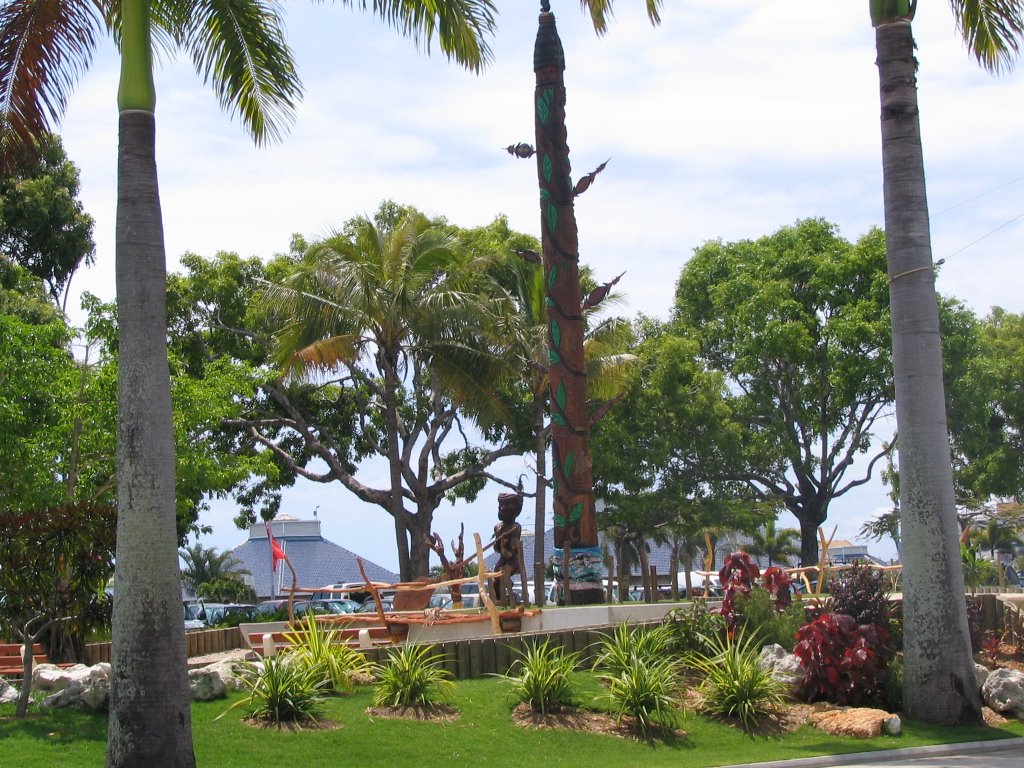
Kanaky is the locals' name for New Caledonia. Kanaky - the land of the Kanaks. In the center of Nouméa you'll find a spot that has been constructed for, and as an homage to, the Kanaks (pictured above). Of Kanaky's 200 000 or so inhabitants, the Kanaks make up the largest cultural group at 42.5% of the population. The island still belongs to them, in theory (but far from in practice). Unlike what has happened to the American Indians and the Australian Aboriginals, the culture has not been entirely stripped from the Kanaks. Their 32 dialects are still alive, they follow their own customs and laws, they still live in "cases" (huts), but they are also integrated in schools, and less so in the workplace. My feeling is that their land is exploited (for nickel) and that they are little compensated. They are often less qualified for the better jobs in New Caledonia and suffer from poverty and alcoholism. But the fact that their culture still lives gives me hope that they will one day regain possession and power of their homeland.

05 July 2006

Spot the Tourist!

My mom visited all the way from Florida some weeks ago and a wonderful time was had by all. We made another visit to Phare Amédée, visited the Parc Forestier and enjoyed a guided visit of the Centre Tjibaou. Pablo joined us on all these outings (as captured above) at the ripe old age of 6-8 weeks old. Born here, I guess he doesn't really count as a tourist, but we do stand out in New Caledonia. Maybe it is our pale skin, our reddish hair, our metropolitan clothes. Maybe it is the money we bring to the island, our English-speaking ways, our love of this place. But no matter, we love it here, minorities or no.

25 December 2005

Ile des Pins: Bingo Anyone?

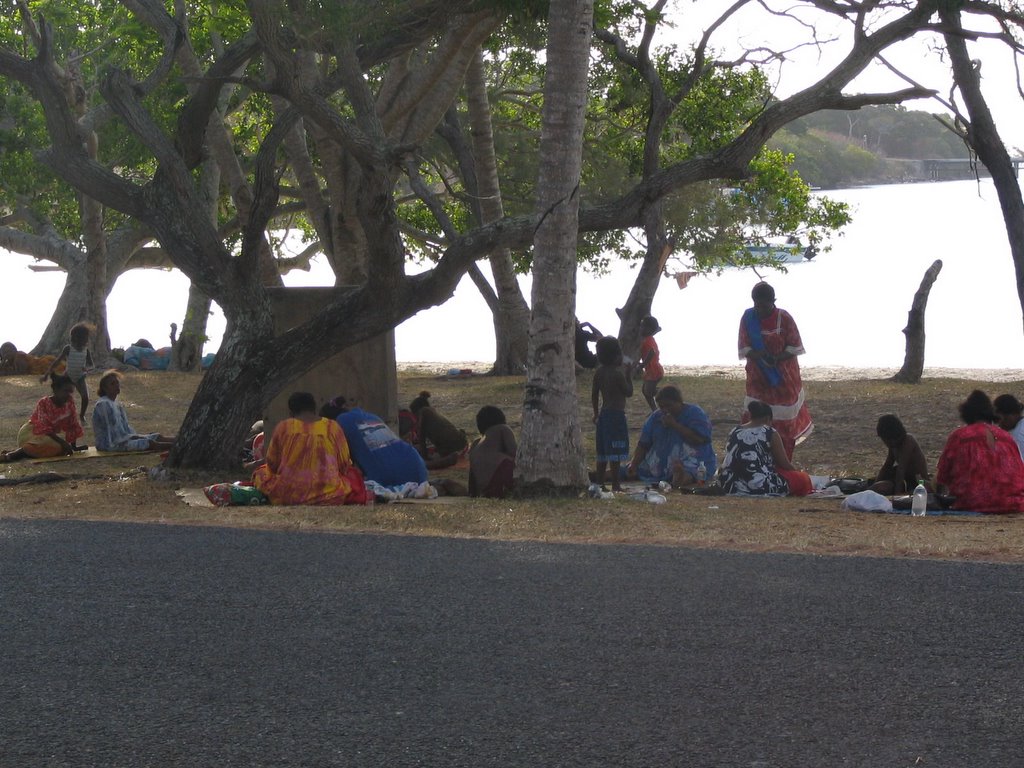
Make no mistake - this is not a picnic. The sun set on Christmas day and the Kunies came out to play "boules", and as pictured here, the women to play bingo. When we asked why there were so few locals out on Christmas day, we were told by our Kunie driver that they were all at home, resting and recuperating, still somewhat inebriated, having started drinking just after midnight mass. By the time the sun set, the locals came out again to liven up island life.

Photo by Laurent Guiader, 2005.

06 December 2005

A Country Thrice Divided

New Caledonia has three discernible populations (of a total of 230 789 inhabitants):

- The Kanak (or Kanaky), which are the country's indigenous peoples. As of 2005, the Kanak community represents 42.5% of the population. They are officially known as Melanesians.

- The Caldoche, which are the whites who have lived in New Caledonia for several generations. The Caldoche usually refer to themselves simply as "calédoniens" and may be either white (mostly French or German) or white with a mixture of Asian, Melanesian or Polynesian ancestry. Caldoche culture is said to have many similarities with Australian and Afrikaner culture.

- The Métros or Métropolitains, which are the newcomers who have immigrated from metropolitan France.

I have been thinking a lot about these three very separate groups this last week as I interact primarily with the Kanaks and the Métros and have had occasion to be involved in heated conversations about the driving forces in each population. I hope to address some of the tensions between the populations in the coming months - as I come to understand them - on this blog ...

As a start, I visited the Centre Culturel Tijbaou today - see http://www.adck.nc/ - and got my first primer on some of the most important customs and traditions in the Kanak culture. More to follow!